
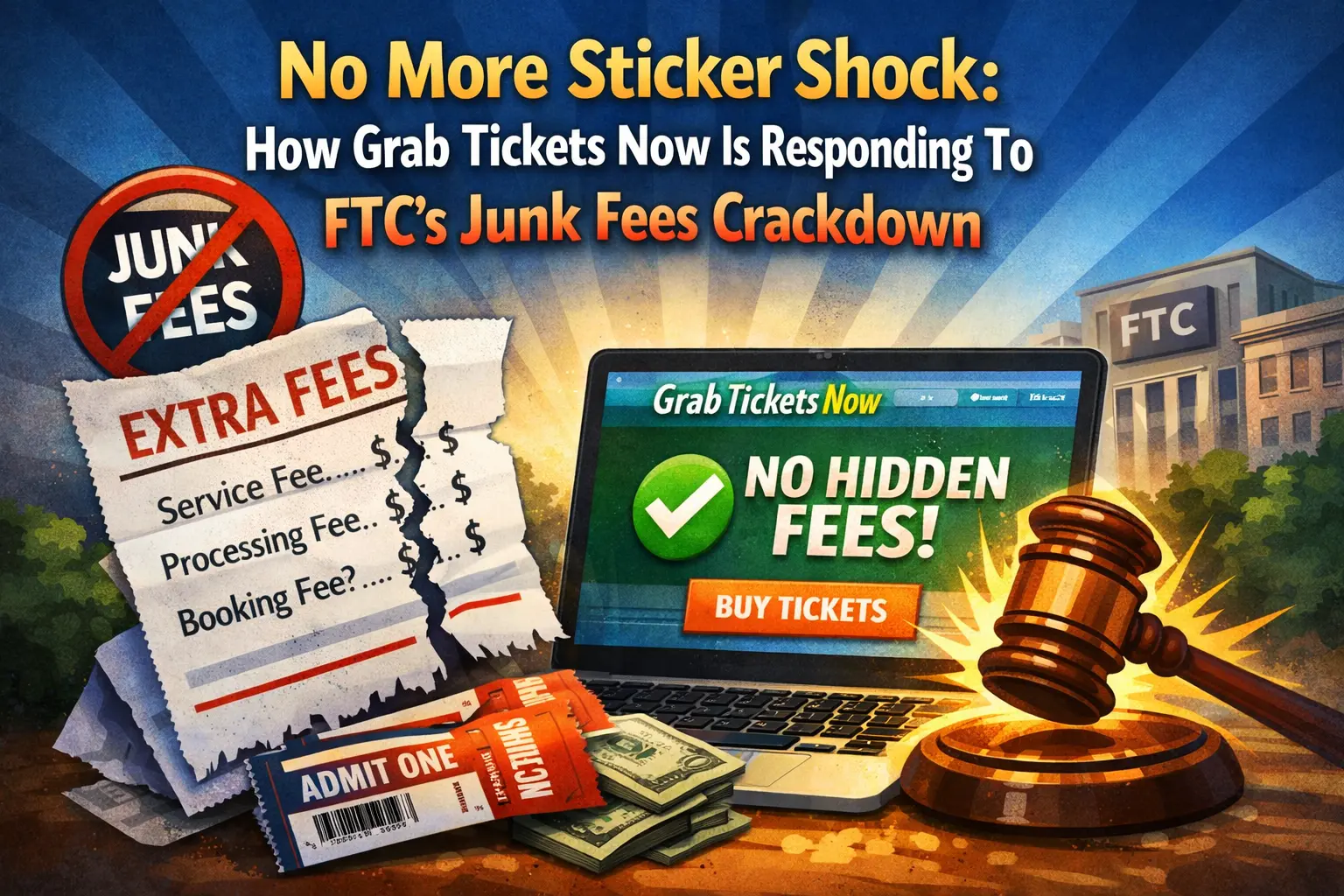
No More Sticker Shock: How Grab Tickets Now Is Responding To The FTC’s Junk Fees Crackdown
Opening: From “junk fees” to honest totals
If you buy tickets online, you already know the move: a low price pulls you in, and by the time you hit the last checkout screen, a stack of fees has quietly pushed the total way up. Regulators call these hidden add‑ons “junk fees,” and in the last year the US has taken direct aim at them across travel, rentals, and live‑event ticketing.
For ticket buyers, the shift is simple but powerful: the first price you see is supposed to be the real price, not a teaser that jumps just before you pay. At Grab Tickets Now, that’s the standard the team is building towards with transparent, all‑in pricing across sports, concerts, and theater events.
The new rules: what the FTC Junk Fees Rule actually does
The main policy move for ticketing is the Federal Trade Commission’s Trade Regulation Rule on Unfair or Deceptive Fees, often shortened to the FTC Junk Fees Rule. In plain English, here’s what matters most to fans:
- It is considered unfair or deceptive to advertise or display a ticket price and then hide mandatory fees until late in checkout. The total has to be in front of you from the start.
- Marketplaces and ticket sellers must clearly and prominently show the total price, including required service and platform fees, wherever prices are shown, not just on the final screen. Partial prices can’t be the star of the show.
- Confusing fee labels that make required charges look optional or trivial are off‑side. If you must pay it to get the ticket, regulators treat it as part of the price, not a surprise add‑on.
If you want to go straight to the source, you can read the law itself here:
-
Federal Register rule text (full legal version)
-
FTC overview and business guidance (plain-language summary)
This rule sits inside a broader push to clean up hidden fees in hotels, rentals, and travel as well, and some related fee rules in other sectors have already been tested in court, which shows how active this area is.
What this means for you when you buy tickets
From a fan’s perspective, the intent behind all of this is straightforward.
- The price that grabs your attention should be an all‑in price, not the “before we tell you the truth” number.
- You shouldn’t have to guess which charges are mandatory and which are optional add‑ons.
- Comparing offers across different ticket sites should be possible using real totals, not lowball starting numbers.
That is the bar Grab Tickets Now is designing around with its pricing experience.
-
For sports, you can see events and pricing from the Sports hub at
-
For concerts, browse live music and festivals at
-
For theater, explore shows at
How Grab Tickets Now is changing its pricing experience
Grab Tickets Now operates as a ticket marketplace, connecting fans to live events across categories like sports, concerts, and theater. The company is using the FTC Junk Fees Rule as a catalyst to sharpen the entire buying experience around clarity and trust.
1. Leading with the all‑in price
When you browse events on Grab Tickets Now, the aim is that the primary price you see for a ticket is the all‑in number that already includes mandatory marketplace and service fees. That price becomes the anchor throughout your journey, not just at the last step.
Any breakdown of “ticket price + fees” is there to explain how the total is built, not to hide fees behind a lower headline price. That structure mirrors what the FTC expects: the true total must be clear, conspicuous, and not overshadowed by partial prices.
2. Straightforward language around fees
Instead of burying fees under vague names, Grab Tickets Now uses simple labels that spell out what each charge covers, like secure payment processing or support. The idea is that a fan can look at the breakdown and instantly understand what is mandatory versus optional.
Optional extras such as ticket insurance or parking remain separate choices. They are not baked into the main price unless you actively select them, which is consistent with the FTC’s push to distinguish true junk fees from voluntary add‑ons.
3. Keeping the price stable from browse to checkout
One of the most frustrating parts of buying tickets is seeing a good price on the event list, only to watch it climb as you click deeper. Under the new rule, that pattern is exactly what regulators want to stop.
Grab Tickets Now is structuring its flow so the total price you see early in the process is the same total you see at checkout, aside from clearly disclosed government taxes or delivery choices that appear before you pay. That consistency means you can focus on seat quality and timing instead of worrying about a surprise jump at the last second.
4. Setting standards for marketplace partners
Because Grab Tickets Now works with multiple partners who list inventory through the platform, transparency cannot stop at the platform level. Each partner is expected to follow the same all‑in pricing principles so that every listing lines up with the FTC’s requirements.
Internal checks help flag any listings that look inconsistent or non‑compliant. When that happens, the listing can be corrected or removed to protect fans and keep the experience aligned with the rule. The regulation explicitly reaches intermediaries and marketplaces, so enforcing standards across the ecosystem is part of staying onside.
Simple checklist: what ticket buyers should do now
Regulations help, but smart buying habits still matter. Here is a quick checklist to use every time you shop for tickets, on Grab Tickets Now or anywhere else.
- Focus on the all‑in number.
Treat the total price (including mandatory fees) as your true comparison point between different sites and offers. - Separate mandatory fees from optional extras.
Anything required to complete the purchase should be baked into the total. Optional add‑ons should be clearly presented as choices, not hidden requirements. - Compare final totals, not teaser prices.
Two sites can show similar base prices but very different all‑in totals once you factor in fees. Always compare the total you will actually pay. - Read refund, cancellation, and postponement policies.
Especially for high‑demand sports, concerts, and theater events, understand what happens if a date moves, a show is postponed, or you can’t attend. - Use promo codes to improve value, not to justify bad pricing.
https://www.grabticketsnow.com/page/promo-codes
A good promo code should reduce a transparent total, not distract from unclear fees. If a discount looks amazing but the fee structure is murky, treat that as a red flag.
Following this checklist lets you take advantage of the legal protections while still making sharp, value‑driven buying decisions.
FAQs: Junk fees, the FTC rule, and Grab Tickets Now
-
In simple terms, what is the FTC Junk Fees Rule?
It is a federal rule that treats it as unfair or deceptive to hide mandatory fees until late in checkout and requires businesses, including live‑event ticket marketplaces, to clearly show the total price upfront wherever they display prices.
-
How is Grab Tickets Now responding to the rule?
Grab Tickets Now is aligning its pricing displays, fee labels, and marketplace standards so that mandatory fees are visible in the main price from the start, with clear explanations and consistent totals from browse to checkout.
-
Are all fees included in the first price I see?
he intent under the rule is that mandatory marketplace and service fees are reflected in the most prominent price, with any remaining taxes or delivery charges clearly disclosed before you pay. If you ever see a big jump at the last step, that is exactly the kind of pattern regulators are trying to eliminate.
-
Does this change how promo codes work?
Promo codes still lower what you pay, but they are not supposed to be used to mask incomplete pricing. A discount should apply to a clear, all‑in total, not to a base price that excludes mandatory fees.
-
Where can I read the official law text myself?
You can read the full rule in the Federal Register here:
-
Trade Regulation Rule on Unfair or Deceptive Fees
-
For a more narrative summary and background, you can also review the FTC’s own overview and announcement
-